
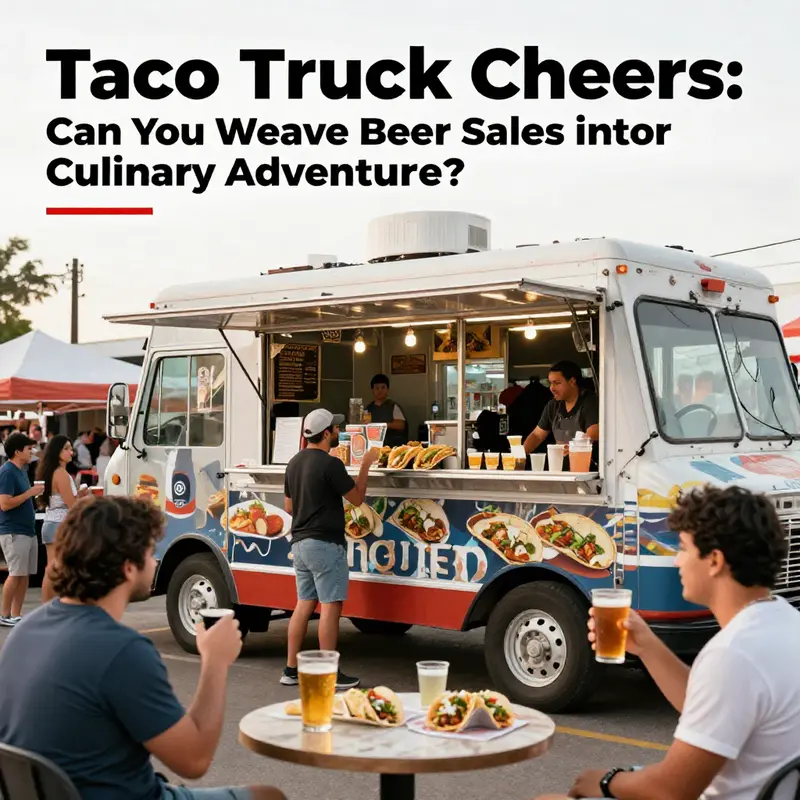
Taco trucks are becoming a staple in urban dining, serving up mouthwatering meals to busy commuters and adventurers seeking outdoor fun. But have you ever thought about how refreshing it would be to pair a cold beer with those delicious tacos on a sunny day? Selling beer from a taco truck can be a lucrative venture, but it requires a good understanding of legalities. With the right permits and precautions in place, you could create a unique dining experience that sets your taco truck apart. Let’s explore the essential steps you need to take in this guide, from understanding necessary permits to ensuring compliance with local regulations and protecting yourself with appropriate insurance. Join us on this flavorful journey to make your taco truck business even more exciting!
null
null
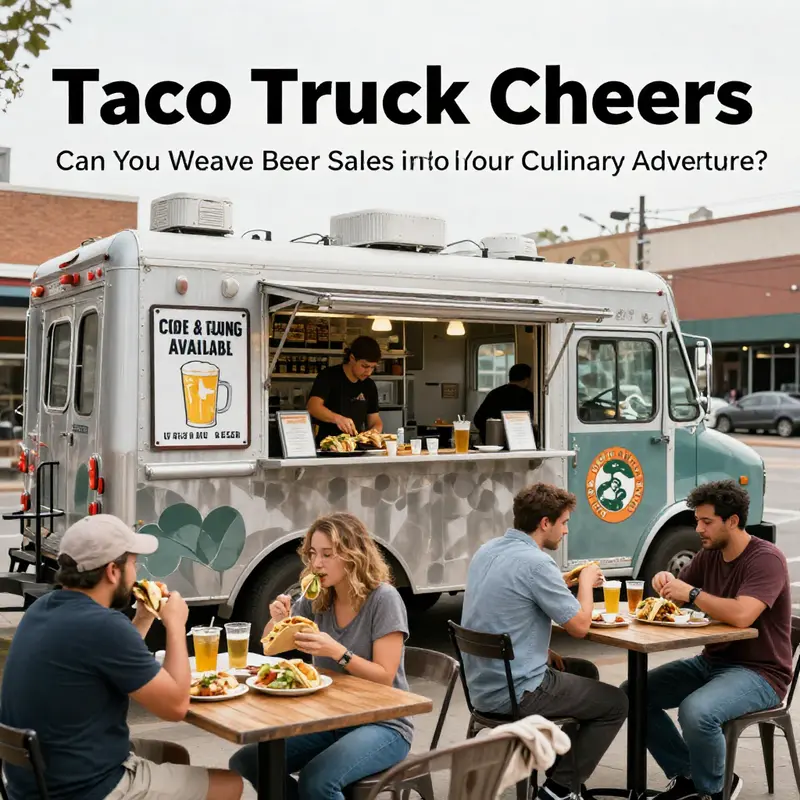
Local Laws, Lager, and the Taco Cart: How Rules Shape Beer Sales from Mobile Kitchens
The street hums with the sizzle of peppers, the bright glare of neon signs, and the shared anticipation of a good meal on wheels. A taco truck weaves through a curbside crowd, condensing an entire urban economy into a compact kitchen on wheels. Yet behind the aroma of cumin and fried tortilla lies a deeper, less visible economy of licenses, permits, and long-standing legal structures. The question that often surfaces as customers raise a chilled bottle or a can is not simply about taste or demand. It is about whether beer can legally ride shotgun with tacos, and if so, under what exact terms. The answer, in most places, is yes—but with a precise map of permissions that must be read in full before you tilt the beer taps toward customers. In many jurisdictions, beer sales from a taco truck are not a casual add-on. They are a regulated activity that sits at the intersection of food service, alcohol control, and local governance. Crossing that line without the right licenses can transform a bustling lunch stop into a liability nightmare, a shutdown notice, or a headline about noncompliance that no neighborhood wants to own. This chapter traces the legal terrain that underpins beer sales from mobile food vendors, showing how regulations shape strategy, operations, and community impact. It is a story of opportunity restrained by rules, opportunity that becomes actionable only when the paperwork aligns with place, pace, and policy.
The starting point is straightforward in concept but often complex in practice: you must operate as a legitimate food establishment to serve food, and you must obtain a separate, dedicated alcohol license to sell beer. In many locales, these two regulatory streams run on parallel rails. A food service permit establishes that your taco truck meets health, safety, and sanitation standards. It confirms that you handle, store, and prepare food in a manner that protects public health. The alcohol license, by contrast, is a specialized authorization that confirms you have the legal right to sell alcoholic beverages. The type of license you need—beer-only, beer-and-wine, or a full liquor license—depends heavily on local rules and the nature of service you intend to offer. Some jurisdictions grant a specific permit for mobile vendors that want to sell alcohol, while others require you to participate in a more general license class that covers stationary establishments and pop-up contexts alike. The practical effect of these differences is that many taco trucks discover a built-in constraint: even if you operate cleanly and legally as a food business, you still face a separate licensing gauntlet for alcohol, with its own prerequisites, inspections, and compliance timelines.
This regulatory framework matters because beer sales magnify risk as well as revenue. Alcohol alters the liability calculus, and many regions require alcohol-specific liability insurance in addition to standard general coverage. You may also encounter staffing requirements that touch on responsible service: trained employees who can verify age, recognize signs of intoxication, and de-escalate tense situations. In some places, a license to sell beer may be tethered to operational conditions like restricted hours, limits on where you can park or set up, or mandatory separation between beer service zones and certain sensitive locations. The social implications are real as well. Beer can draw larger crowds, create longer lines, and increase street-level footfall. That footfall can be a boon for neighborhood vitality, but without careful compliance planning, it can also trigger noise complaints, sanitation challenges, and traffic concerns that invite regulatory pushback.
The regional mosaic of local regulations is where the real complexity lives. While the concept of a mobile food vendor selling beer is common in many parts of the United States, the details differ widely from city to city, county to county, and state to state. Take California, for example. In that state, mobile vendors can pursue on-premises or off-premises alcohol licenses, but they must meet zoning constraints and proximity requirements. The practical effect is that an otherwise mobile business may not freely roam anywhere: you may be restricted from selling near schools, churches, or certain residential zones, and you may need to anchor your operation within a permissible zone or under a permitted program. This delicate choreography of location, license, and timing can feel antithetical to the spontaneous spirit of street food, but it is exactly what keeps the regulatory system functional.
By contrast, some major urban centers take a stricter stance on alcohol sales by food trucks. In cities where the regulatory appetite for alcohol sales by mobile vendors is limited, vendors find themselves leaning toward events, partnerships, or temporary permits rather than continuous, street-side beer service. For instance, in a dense market like a large metropolitan area, the appetite for issuing regular, mobile beer licenses can be tempered by concerns about public safety, crowd control, and the impact on existing bars and restaurants. The practical upshot is that a taco truck in such a city might operate beer service only during curated events or within the framework of a larger license held by a partner venue. This isn’t a verdict on the viability of beer-taco pairings; it’s a reminder that regulatory ecosystems are built from historical balances between commerce, public safety, and neighborhood character.
Another layer of nuance emerges when you examine specific state portraits. In states with expansive licensing frameworks, a taco truck may obtain a beer-only license that permits selling bottled or canned beer for off-premises consumption. If you want to offer draft beer from kegs, you typically step into a more comprehensive licensing class that aligns with on-premises consumption, beer-and-wine, or even liquor licenses, depending on the jurisdiction. Some locales require a separate permit unique to mobile vendors, designed to address the mobility factor—the fact that the vendor’s location, and therefore its customers, can shift from block to block and from market to market. The practical reality here is that beer sales for a taco truck are not a simple add-on; they are an ongoing regulatory project that demands an integrated approach to licensing, safety, and location strategy.
The stakes become clearer when you consider what happens if a truck forgets to secure one of these licenses or misinterprets the permit terms. The consequences can be swift and severe: fines, a forced shutdown, a mandated cessation of beer service, or criminal exposure in extreme cases. Even when compliance is achieved, the ongoing obligations can be rigorous. You may be required to document and audit beer purchases, maintain a precise inventory log, or submit periodic reports to a licensing authority. You may also be required to display permits prominently, ensure that all staff understand alcohol service rules, and implement a policy for checking IDs consistently. In short, the alcohol license is not a one-time stamp of approval. It is a living instrument that requires ongoing management, periodic renewal, and adherence to evolving local standards.
The Virginia example, highlighted in recent reporting on the so-called taco truck prohibition, is a stark reminder of how regulatory lag can slow an otherwise vibrant entrepreneurial ecosystem. In Virginia, as described in a detailed analysis of the state’s alcohol sales framework, street-food vendors like taco trucks face a prohibition on serving beer or other alcoholic beverages without obtaining a special license. Even where a truck has a valid food service license, the extra step of securing the appropriate alcohol license is necessary, and the path to that license can be tangled in antiquated statutes and cautious local policies. The upshot is a signal to operators that lawmaking often lags behind the pace of business innovation. Small, nimble vendors and local craft producers may want to collaborate to deliver a seamless food-and-beverage experience, yet outdated legal text can stand in the way of such collaboration. The broader business community is forced to adapt, find workarounds, or advocate for reform, while customers continue to expect the same convenient pairing of convenience and quality they associate with street food. The Washington Post’s reporting on this topic underscores how history can constrain modern commerce, even as consumer tastes push toward more integrated, experiential food experiences.
Within this regulatory labyrinth, a practical approach emerges for operators who aim to responsibly expand their offerings without inviting undue risk. First, the baseline is always the health department’s food service standards. A taco truck must meet those standards consistently—proper handwashing facilities, safe refrigeration, correct food temperatures, clean preparation surfaces, and strict sanitation protocols. Only after these foundations are in place should an operator pursue alcohol licensing. The alcohol licensing process often starts with a local alcohol control authority or equivalent entity, which will outline the exact licenses, permits, and associated fees required for beer sales. You may discover that the path to a beer-only license is procedurally simpler than the path to a full beer-and-wine or liquor license, but the alcohol authority may still require proof of business location, compliance with zoning rules, proof of insurance, and even a demonstration of responsible service practices.
An often-underappreciated dimension is the community and urban planning context. Local governments weigh the benefits of mobile vendors expanding street-level entrepreneurship against concerns about traffic, noise, and the impact on brick-and-mortar dining establishments. Some neighborhoods welcome beer-enabled food trucks as a way to enliven blocks and diversify the culinary mix, while others resist the additional complexity that alcohol sales introduce to curbside commerce. The decision to permit beer sales from a taco truck is thus not simply a matter of a business’s desire to expand product offerings. It is a negotiation with place. It involves visibility—how the truck is parked, how long it stays, and how well it integrates with the surrounding activity. It involves crowd management—how lines are formed, how customers are directed, and how staff handle long queues. It involves safety—how the operation prevents underage sales, how it handles intoxicated patrons, and how it coordinates with local law enforcement and emergency services if needed. For a small operator, the collective weight of these factors can be substantial, and it’s easy to underestimate how much time and resource compliance will demand.
This is not merely a legal exercise; it is a strategic one. The opportunity to pair beer with tacos can yield meaningful economic benefits: attracting new customers, extending service hours, and creating partnerships with local breweries that want to reach taprooms’ adjacent neighborhoods. Yet the opportunities depend on a well-orchestrated compliance program. It starts with a clear understanding of the two-layer licensing structure—the food-service framework and the alcohol-licensing framework—and it requires bridging them through careful planning. It may involve designating a dedicated beer service area on the truck that is physically separated from food preparation zones, ensuring that glassware and bottle storage meet safety standards, and implementing a reliable ID-checking protocol for every customer. It may also mean using inventory controls that track beer purchases and ensure that products come from licensed suppliers, a detail that resonates with federal and state law where unlicensed distribution channels can trip penalties.
It is also essential to consider staff training, not merely as a nice-to-have but as a compliance cornerstone. Operators should implement a straightforward program for teaching servers to recognize signs of intoxication, to refuse service when appropriate, and to manage crowded lines in a way that reduces conflict. While there is a temptation to simplify operations by outsourcing or delegating alcohol service entirely to partners, doing so can complicate accountability. Clear lines of responsibility—who is authorized to sell, how to handle a failed ID check, how to manage refunds or exchanges, and how to document incidents—help ensure that the business remains compliant even during peak hours. In some jurisdictions, staff training is itself a license-approval condition, as authorities seek to fortify the environment around alcohol sales with consistent, professional service.
On the supply side, the chain must be legible and compliant. Beer procurement should come from licensed manufacturers or distributors, with robust records showing the products’ origin and tax status. The presence of a regulated supply chain confirms that the business operates within the framework designed to prevent illicit alcohol distribution, protect consumers, and maintain fair market conditions for all players in the food-and-beverage ecosystem. This is not merely a box-ticking exercise. It reinforces consumer trust and contributes to a more stable operating environment, which in turn makes it easier to plan for growth and to negotiate with neighborhoods and event organizers about future beer-enabled opportunities.
All of these considerations converge on a practical, implementable mindset: treat alcohol sales as a regulated extension of your food service, not as a casual add-on or a way to chase impulse buyers. The most resilient operators position themselves for long-term success by aligning their business model with the realities of licensing, inspections, and community norms. They recognize that the beer component, when properly licensed and responsibly managed, can complement the culinary narrative of a taco truck. The beer becomes not just a beverage but a bridge—connecting people, flavors, and places in a way that honors both the craft of brewing and the art of street-side hospitality. In places where laws continue to evolve, this mindset also means maintaining a line of communication with regulators, staying informed about proposed changes, and being prepared to adapt operations in a manner that preserves safety and community trust while expanding opportunity.
The historical and regulatory context matters precisely because it informs strategy. The example of Virginia, where historical statutes have constrained beer sales by food trucks without special permission, serves as a case study in the friction between long-standing law and modern business models. It invites industry participants to engage with policymakers, advocate for modernized frameworks that reflect current urban economies, and design compliance programs that demonstrate both safety and responsibility. Reform tends to be incremental, but it is driven by examples of successful pilots, thoughtful licensing processes, and evidence that beer-enabled food trucks can contribute to local tourism, craft-beer ecosystems, and neighborhood vitality without compromising public safety.
In the end, the question is not simply whether beer can be sold from a taco truck, but whether a business can do so in a way that is transparent, compliant, and attuned to the conditions of its community. The right licenses unlock that possibility, but the right approach keeps it sustainable. The licensing journey—health permit first, alcohol license second, and ongoing compliance as a continuous practice—produces a dependable platform for growth. It demands patience, because the licensing process is, by design, a slow river that carves the landscape over time. Yet for the right operator, the river flow is navigable, and the destination—an inviting, socially responsible business that offers both food and beer to a diverse customer base—becomes achievable.
For readers who are contemplating the path, the essential takeaways are practical and actionable. Start with the health department standards that govern any food operation, ensuring that your truck’s kitchen is a model of cleanliness, safety, and sanitation. Then engage the local alcohol control authority to understand precisely which licenses are needed for your intended model—beer-only, beer-and-wine, or a broader license—and whether there are special permits for mobile vendors. Map your operating geography carefully, accounting for zoning, proximity restrictions, and event-based allowances. Build a compliance framework that covers insurance, staff training, ID verification, inventory controls, and supplier legitimacy. Finally, look for opportunities to collaborate with local breweries and event organizers in ways that respect the regulatory boundaries while expanding the market for both food and beer. In doing so, you align compelling culinary experiences with a law-abiding business model that can weather regulatory changes and community concerns alike.
The evolving story of beer on the taco truck is not just about changes in statutes; it is about how smart operators interpret rules, engage communities, and deliver delight in a way that is lawful, safe, and scalable. It is about transforming a curbside culinary moment into a dependable, repeatable experience that honors both the craft culture of beer and the hard-won craft of street-food entrepreneurship. When law and labor and love of good food converge, the taco cart becomes more than a food vehicle. It becomes a platform for neighborhood connection, a catalyst for local brewing partnerships, and a model for how micro-entrepreneurship can thrive in a city that values flavor, safety, and innovation. For operators who are ready to navigate the landscape with diligence and humility, the beer-and-taco pairing presents not just a product mix but a responsible way to participate in a bustling, dynamic urban economy.
External resource for broader context: https://www.washingtonpost.com/business/2025/09/19/taco-truck-prohibition-virginia-laws/
Internal reference for compliance-minded practice: sustainable-practices-mobile-trucks
Shielding the Sip: Insurance, Liability, and the Legal Guardrails of Selling Beer from a Taco Truck
The idea of pairing sizzling carne asada with a cold beer from a taco truck is enticing. It promises a more complete experience for customers and the potential to capture a broader crowd at lunch markets, festivals, and curbside stops. Yet the romance of a mobile beer offering quickly yields to a hard truth: selling alcohol from a taco truck amplifies risk in ways that food alone does not. The equipment, the customers, the open street environment, and the perishable nature of beer all converge with legal obligations that require thoughtful planning, precise licensing, and a robust shield of insurance. In practice, the path from an approved food operation to a legally compliant, safely run beer service is a long hallway of requirements. It is navigable, but it demands discipline, attentiveness to detail, and a willingness to invest in protection before profit.
The starting point is to recognize that beer, unlike most food items, is a regulated product with a chain of control that begins with licensing and extends through service. The basic premise is straightforward: you may sell beer from a taco truck, but only if you secure the appropriate licenses and permits and operate within the boundaries those permissions set. The stakes are not merely about avoiding a fine; they include avoiding license revocation, personal liability, and the potential for serious civil claims. The licensing landscape is built on layers. There is the food service license that legitimizes your operation as a food establishment. Without that, adding alcohol would be a nonstarter. Then there is the alcohol license, which varies widely by jurisdiction and type of service. A beer-only license might suffice for canned or bottled products, while draft beer or a broader beverage offering could require a more comprehensive license. Some locales also require a specific permit for mobile vendors. The sum of these permissions is the legal passport that allows you to pour, serve, and sell alcohol in a moving, street-front setting.
Regulatory nuance matters deeply. Localities shape the framework that determines not only what licenses you need but where and when you can dispense beer. For example, conclusions drawn from practice in one city may be useless in another without adaptation to zoning, proximity to sensitive institutions, and even seasonality of business activity. The interplay between city rules, state controls, and federal guidelines creates a mosaic that demands careful, proactive research. In some regions, mobile vendors can apply for on-premises licenses that allow service at temporary or outdoor venues, while others restrict alcohol sales to fixed, brick-and-mortar establishments unless special arrangements are made. These differences make it essential to engage with the right authorities early—your local county health department for the food-service side, and your state alcohol control board for the beverage side. A misstep here is costly: fines, license suspension, or permanent loss of the ability to sell alcohol in the future.
If you move forward, you enter the realm of risk management with a clear-eyed view of what could go wrong. Liquor liability exposure is the centerpiece of this reality. A single incident—whether a patron overindulges, a vehicle collision follows a ride-after-drinking decision, or a dispute erupts over service boundaries—can generate claims that exceed personal assets. Liquor liability insurance becomes not just prudent but essential. It provides a safety net for legal defense costs and potential settlements, up to the policy limits. The coverage addresses not only civil actions but also the broader consequences of alcohol-related events, such as reputational harm or disruptions to your operation. The second layer, general liability insurance, covers a spectrum of day-to-day risks inherent in any customer-facing business. It protects against slips and falls on a wet surface near the truck, property damage to equipment or bystanders, and advertising injuries that might arise from promotional language or imagery. Together, these two core coverages form the backbone of protection for most mobile food ventures that add alcohol to their menu.
The trucking element of the business introduces its own ins and outs. Because the taco truck is a vehicle, commercial auto insurance is non-negotiable. Personal auto policies typically exclude business use, especially when beer, inventory, and cash flow move between events, markets, and pop-up venues. Comprehensive auto coverage is designed to respond to accidents, theft, and damage to the truck itself, while also addressing liability arising from incidents involving other vehicles or pedestrians. In many policies, it also extends to cargo—your beer inventory—in transit, which adds another layer of protection against loss, spoilage, or damage at loading docks and during rapid, on-the-fly setups. The auto policy should coordinate with your general liability program so that gaps do not emerge in the event of a claim that touches both driving and serving aspects of the operation.
Beyond the two broad foundations of liquor and general liability, there are other policies and considerations that frequently surface in discussion and underwriting. Workers’ compensation becomes relevant if you employ staff, providing coverage for injuries that occur on the line or during truck-related tasks. Product liability insurance, while often associated with food safety, can extend to claims tied to contamination or mislabeling that causes consumer harm. Cyber liability might seem distant for a street-food vendor, but if you collect customer data through digital ordering apps or loyalty programs, protecting that information becomes part of the risk calculus. Finally, while not strictly insurance, establishing a robust set of operating procedures—ID checks, a clearly communicated last-call and cut-off policy, and a designated driver plan—complements insurance by reducing the frequency and severity of incidents.
In practical terms, the service rules around alcohol are not optional add-ons; they are core operational requirements. Staff training is a critical component, often mandated by state or local authorities or encouraged by insurers. Responsible beverage service training, often abbreviated as RBS or a program like TIPS in some regions, equips servers to recognize signs of over-consumption, to refuse service when necessary, and to manage the pacing of pours and the handling of intoxicated patrons in a way that minimizes risk to others. The training also supports a consistent standard across shifts, which is important for a mobile operation where the customer mix and seating arrangements can vary from one stop to the next. A well-trained team reduces the likelihood of disputes, injuries, or service-related liabilities and creates a culture of safety that resonates with customers and event organizers alike.
From a compliance perspective, federal, state, and local laws intersect in complex ways. The federal layer, primarily enforced by the Alcohol and Tobacco Tax and Trade Bureau (TTB), governs production, labeling, and distribution, and it requires that alcohol be sourced from licensed suppliers. The state governs the retail licensing and the specifics of where and how alcohol can be sold. Local jurisdictions layer in zoning restrictions, proximity rules to sensitive institutions, and the operational realities of mobile vendors—such as permits for street vending, allowable hours, and location-based restrictions. The practical implication is simple: you must verify that your beer comes from licensed sources and that every step of the supply chain is compliant. This is not a one-and-done check; it requires ongoing diligence as licenses are renewed, as staffing changes, and as you move through different markets or events.
With all these requirements, it is easy to feel overwhelmed. The antidote is a structured, proactive approach. Start with a licensing checklist that maps out the specific permits and licenses your operation needs in your city, state, and any counties where you plan to operate. Then build an insurance package that layers liquor liability, general liability, and commercial auto, with additional coverages tailored to your planned volume and risk profile. The premium costs should be viewed as a cost of doing business—an investment in risk management that reduces the probability of an existential setback. Remember that coverage is not a passport to reckless operation; it is a safety net that allows you to respond properly when things go wrong and to maintain the confidence of customers, event organizers, and regulators alike.
The value of protective measures becomes even clearer when you consider the operational realities of a moving beverage service. A taco truck operates in dynamic environments: festival grounds, busy street corners, late-night venues, or farmers’ markets. In such settings, the risk of slips, contact with fans, or cross-flow with other vendors increases. A reliable general liability policy helps with the everyday risks—someone tripping on a slick surface or a misdirected spill that damages a device or a passerby. Liquor liability, however, is the hinge upon which the entire operation balances. It anticipates the possibility that a guest may injure themselves or others after consuming alcohol in your vicinity. It anticipates the potential for lawsuits that could reach beyond the truck’s immediate site, given the network of party-goers, rideshare drivers, and family groups that form a typical event crowd. In practice, insurers look for clear signs of responsible operations: documented ID checks, a policy to refuse service to intoxicated patrons, a robust incident log, and a defined plan for handling spilled beer inventory safely and promptly.
A critical, often overlooked, aspect of liability management is inventory control. Beer stock depends on cold-chain integrity, proper storage to prevent spoilage, and secure handling during loading and unloading. Any lapse can become a liability issue if contaminated or spoiled product reaches customers. The risk is not merely reputational; it can trigger product liability concerns and demanded recalls in extreme cases. A disciplined approach to inventory, including routine checks, temperature monitoring, and scheduled restocking synchronized with event timelines, reduces the chances of spoilage and protects you from downstream claims. The same discipline applies to cash handling. Where beer is involved, even small cash-handling errors or misappropriation fears can ripple into larger disputes during audits, affecting both your license and your business standing.
Sustainability and social responsibility can also be woven into the liability fabric. A well-run beer service from a taco truck should include a plan for responsible waste management, including the disposal of glass bottles and cans, and the handling of spent kegs or draught lines if you operate a beer-on-tug system. The public perception of your brand hinges on how you manage these aspects, especially in urban settings where litter and noise are tightly regulated. A commitment to clean, orderly, and respectful operations reinforces your credibility with regulators and local communities, which in turn supports smoother license renewals and fewer confrontations with enforcement authorities.
The practical upshot is clear. If you intend to sell beer from your taco truck, you must treat insurance as a strategic pillar, not a last-minute add-on. Your program should be built around three core pillars: a comprehensive, properly structured insurance suite; rigorous compliance practices that reflect the specifics of the markets you serve; and a disciplined operational culture that emphasizes safety, accountability, and customer care. When these elements align, the business model can flourish, allowing you to deliver a legal, safe, and enjoyable experience that complements your food offerings rather than compromising them. In this sense, insurance and liability considerations are not barriers but enablers—facilitating growth by giving you the confidence to operate in diverse environments while protecting both your assets and your customers’ wellbeing.
For readers seeking a concrete starting point on responsible practice and sustainable operations for mobile food ventures, a resource that outlines practical, field-tested approaches to safety and environmental stewardship is worth a look. It connects the dots between day-to-day operations, risk reduction, and long-term viability for mobile food businesses. Sustainable practices for mobile food trucks provides a framework that, while not a substitute for insurance or licensing, complements them by embedding safety culture into every shift and every stop. This alignment of care, compliance, and accessibility is what ultimately sustains a beer-enabled taco business in a crowded market.
In parallel, it’s prudent to ground your planning in authoritative guidance and official resources. The National Association of Insurance Commissioners offers a breadth of information on liability and insurance essentials for small businesses, including risk assessment, policy selection, and claims handling. Exploring these resources can help ensure that your liability protections evolve in step with your business as it grows, and that you remain equipped to respond to new markets, new events, and new regulatory environments. External resources can be a valuable compass, especially as you expand into regions with different laws and enforcement priorities. This proactive approach to learning and adaptation is what turns a promising concept into a resilient, compliant enterprise that can weather the inevitable uncertainties of operating a mobile beverage service.
External resource: https://www.naic.org
Final thoughts
Selling beer from your taco truck can truly enhance your customers’ experience, but it comes with its challenges. By understanding the necessary permits and local laws, along with the importance of liability insurance, you’ll be better positioned to navigate this endeavor. As you serve up delicious tacos with a cold brew, you not only provide a delightful dining experience but also cultivate a thriving business. Ensure you’re compliant, protected, and ready for all the fun and flavors ahead!