
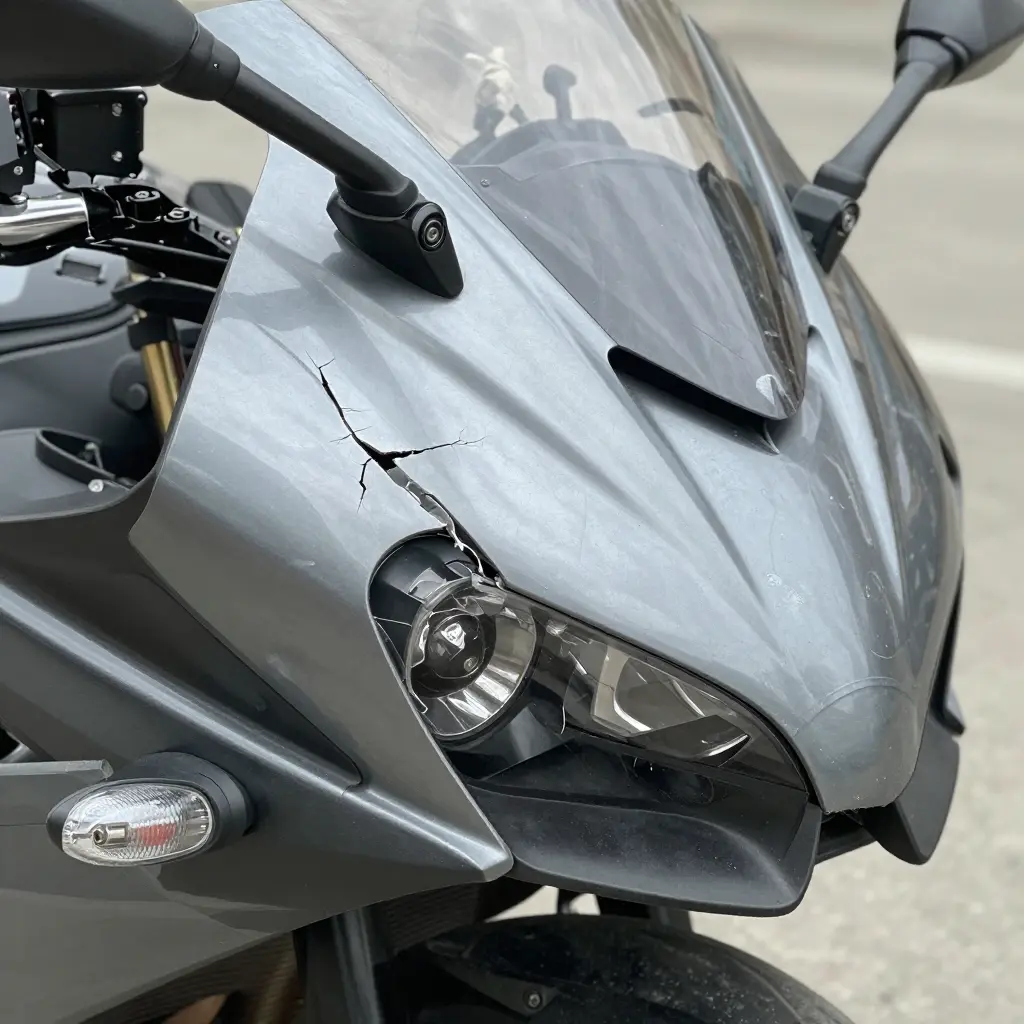
Fairing kit shipping and pre-install damage: what buyers need to know
Most fairing kits arrive intact. When one doesn’t, the damage almost always happened in the carton, not on your bike. A kit ships as a stack of large, thin panels with only light support between them, and that is the arrangement most likely to fail somewhere between the warehouse and your garage.
The two failures reported most often are box crush and cracked ABS. Box crush is a carton that has been stacked, dropped, or squeezed until its walls fold inward. ABS is the acrylonitrile butadiene styrene plastic used in most aftermarket fairings: light, and flexible enough to absorb road vibration. Under a slow squeeze it bends; under a sharp impact it cracks. The thinnest, most exposed points on any panel are the mounting tabs, the small molded brackets that bolt the panel to the frame, so they take the damage first.
None of this is a freak accident. Carriers stack boxes under other freight, load them unevenly, and drop them. That is why inspection comes before installation, before you turn a single bolt.
How Box Crush Happens During Fairing Kit Shipping
A shipping carton is a structure with a load rating, and every fairing crosses the country inside one. Box crush begins when the force on that structure exceeds what its walls can take. In a stacked trailer, each carton carries the weight above it; on a pallet, the pressure compounds from the bottom up, so the lowest boxes carry the most. Corrugated board resists that load along its flutes, and once those vertical columns bend, the board loses most of its stacking strength.
Impacts behave differently. A dropped or tossed carton turns kinetic energy into a sudden force at one point, usually a corner or an edge. Vibration is slower and easier to miss: after hours of road and engine oscillation, panels shift, foam abrades, and the fairing settles against the carton wall. A load that started out evenly spread ends up concentrated on a few millimeters of board.
A carton that is overloaded or under-braced fails in recognizable shapes. It crushes vertically, bows out along a face, or folds at a corner. Each one eats into the clearance inside. As the walls move inward they press on the panels, and any force that reaches the ABS shell travels to the thinnest feature on it, the mounting tab. That is why shipping damage so often shows up at the tabs rather than on the visible outer surface.
Common crush triggers:
- Overstacking beyond the carton’s rated compression strength
- Pallet overhang, which removes corner support and lets edges buckle
- Single-wall corrugate used where double-wall board is required
- Insufficient internal padding, allowing panels to shift and load one area
If you pack fairings yourself, those four points are where to start.
Fairing Kit Shipping Damage: A Quick Comparison
Before you file a claim, or decide whether a panel is worth saving, it helps to know which type of damage you are looking at. Paint care knowledge helps here too: how a scuff or crack is treated affects whether the panel is worth repairing.
| Damage Type | Typical Cause | Visible vs Hidden | Most Affected Parts | Difficulty of Repair |
|---|---|---|---|---|
| Box crush | Stacked freight, dropped pallet | Visible | Main side fairings, nose cowl | Moderate – heat reshaping or replacement |
| Corner collapse | Impact on box corners | Mostly visible | Nose cowl, tail sections | High – cracks and creases spread |
| Puncture | Forklift tine, sharp object | Visible | Any flat panel, mirrors | Moderate – patching weakens thin ABS |
| Moisture damage | Rain, wet warehouse floor | Hidden at first | Decals, primer, gel coat | High – warps thin ABS, ruins finish |
| Mounting tab cracks | Flex, vibration, box crush | Often hidden | Mounting tabs, inner brackets | High – cracked tabs are hard to rebuild and often re-crack |
The damage pattern on the carton usually points to the cause, so photograph it before you unbox and you will know which panels to check first.
Why Thin ABS Cracks at the Mounting Tabs
ABS is the default material for aftermarket and OEM bodywork because it is light and genuinely flexible. Unlike fiberglass, it bends before it breaks, which is why it tolerates the constant vibration of the road. That flexibility has limits. ABS stiffens as it gets colder, and panels that have spent years in ultraviolet light are more brittle than new ones, so the same bump that flexes a fresh panel can crack an aged one.
The weakness sits wherever the panel is thinnest: the mounting tabs and screw bosses that bolt the kit to the frame. A kit ships as a flat stack of unsupported panels, and every bump flexes the sheet. A thick section spreads that motion over a wide area; a tab absorbs all of it within a few millimeters of material. Before the box is even open, repeated flexing in transit can seed hairline cracks at the tab roots and screw bosses, invisible until installation torque finally snaps them. Handling panels gently is as much about protecting painted and plastic surfaces from damage as it is about avoiding dents.
Three mechanical reasons explain why mounting tabs are always the first to go:
- Thin cross-section. The tab carries the panel’s full load through the narrowest slice of material in the whole piece, so stress per square millimeter peaks exactly where it matters most.
- Sharp internal corners. Where the tab meets the main panel, molded right angles act as stress risers, and hairline cracks almost always begin at these inside corners.
- Stress from adjacent panel weight. Every tab supports the leverage of a hanging or shifting section; the longer and heavier that neighbor, the more force the fragile tab root has to resist.
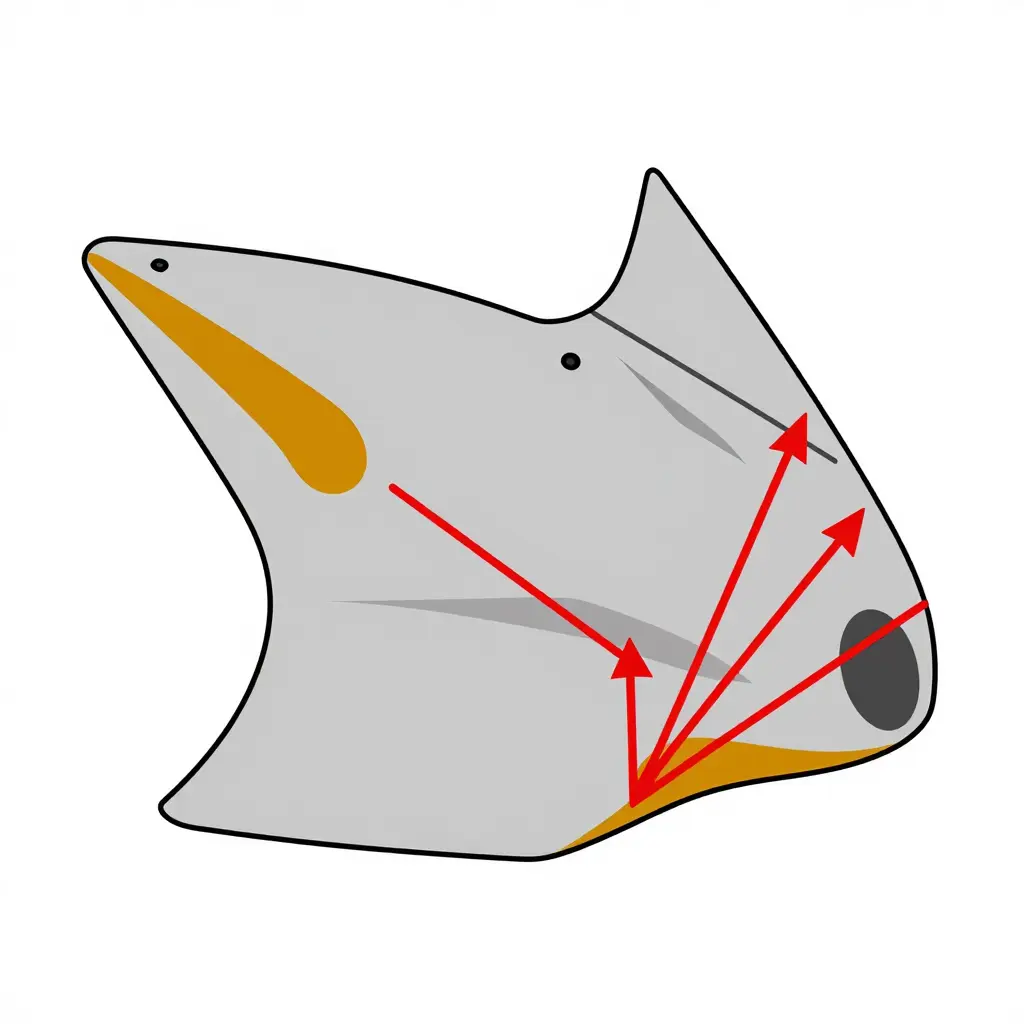
The schematic marks the tab roots, the narrow fillet where each tab meets the panel body. Stacking pressure and side impacts load those transition points rather than the broad flat faces, which is why hairline fractures at the tab base turn up so often on panels that have never been bolted on.
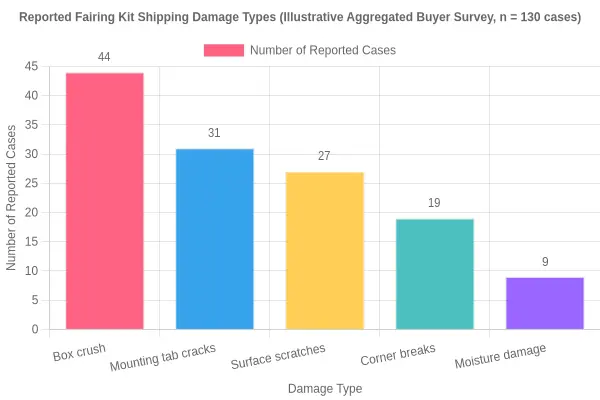
Riders report some damage types far more than others. The chart below covers the five most common, drawn from an illustrative aggregated survey of 130 reported cases, with each bar showing the number of cases for one type: box crush, mounting tab cracks, surface scratches, corner breaks, and moisture damage.
| Damage Type | Reported Cases |
|---|---|
| Box crush | 44 |
| Mounting tab cracks | 31 |
| Surface scratches | 27 |
| Corner breaks | 19 |
| Moisture damage | 9 |
Box crush accounts for 44 of the 130 cases, the largest single share, which fits a failure mode that starts before anyone touches the kit. Mounting tab cracks come next at 31. That fits too: stress concentrates on those thin ABS points whenever a box flexes or gets dropped, and a cracked tab often stays hidden until install. Surface scratches rank third at 27, a smaller but constant complaint for buyers who care about finish, and it is worth reviewing how to prevent surface scratches and coating damage on delicate painted panels. Corner breaks (19) and moisture damage (9) are rarer. Moisture is the one to watch, because water intrusion can soften ABS and set up cracks that only appear days later. For buyers and repair shops the practical order is the same: inspect the carton before signing, and check the mounting tabs first.
Spotting Hidden Box Crush Indicators Before Install
A clean carton proves nothing. Box crush can stress thin ABS panels and crack mounting tabs behind an intact exterior, and you find out halfway through the install, after the return window has started closing.
Work through the kit instead of trusting the label. Lay every piece beside the packing list and match each panel, bolt, grommet, and clip line by line; anything missing, rewrapped, or bundled differently than factory spec suggests the box was opened or repacked after an impact. Then check symmetry: flip each fairing over and sight along its edges against a piece you know is undamaged, comparing curves, gaps, and tab positions. Consistent careful freight handling is your best protection, but the inspection is yours to finish.
Five quiet signs that pressure reached the panels:
- Re-taped or double-layered seams – fresh tape over scuffed or crushed cardboard suggests a carrier or reseller resealed a damaged box.
- Softened, bulged, or pillowed carton faces – spongy or outward-curving walls absorbed an impact that transferred straight to the contents.
- Compressed internal padding – foam blocks, corner guards, or bubble wrap that looks flattened means force squeezed the kit inward.
- Faint crease lines on panel backs – whitish stress streaks on the reverse face are early signs of ABS fatigue.
- Slightly misaligned mounting tab holes – when tabs sit a few millimeters off, the panel has already warped.
Catch these signals early and you can document damage before a single hole is drilled.
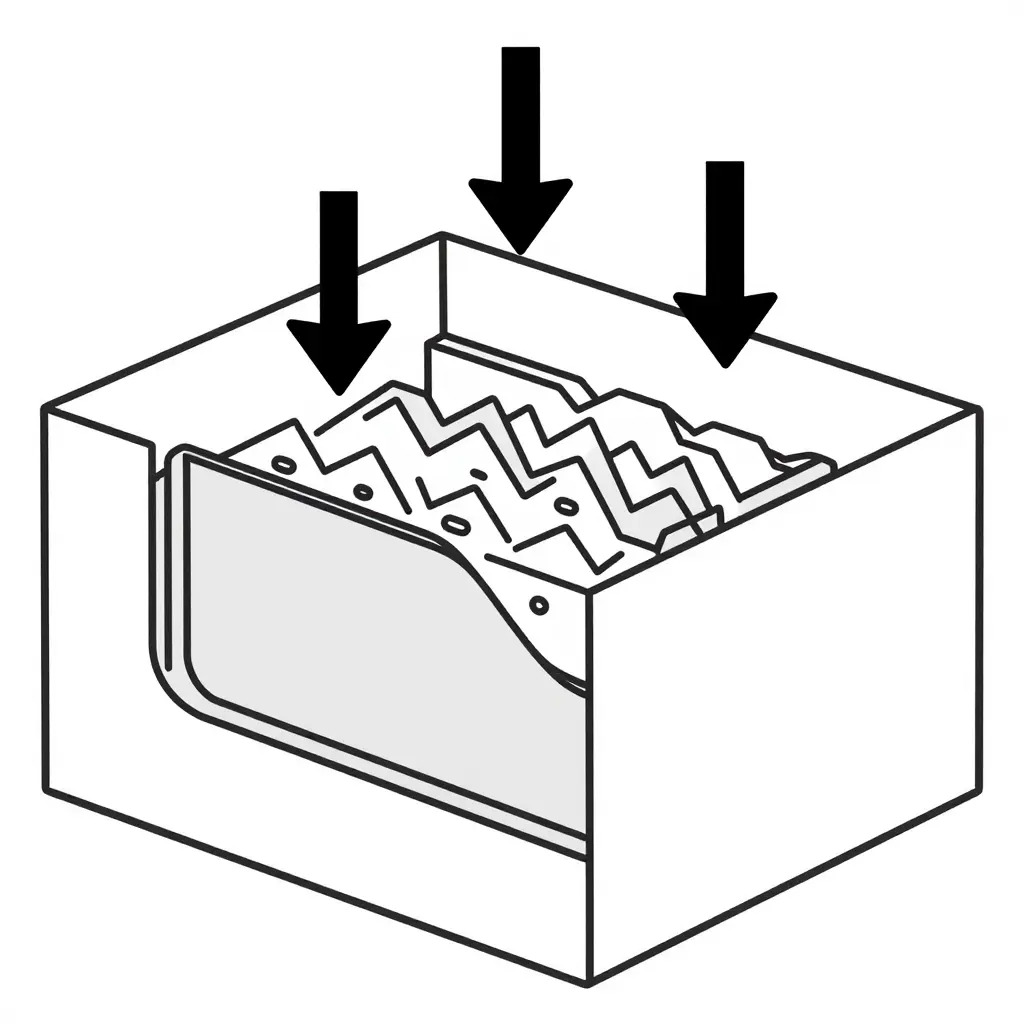
Reading the load path
The second schematic traces where force actually goes the moment a fairing kit gets stacked, dropped, or shoved against other freight. Follow the arrows from the top down:
- Outer carton – stacking weight and impact enter here first. A flimsy corrugated wall bows inward and starts the crush before anything else moves.
- Internal padding layers – corrugated inserts and foam spread that point load across a wider area. When padding is too thin or loosely fitted, the force passes through almost unchanged.
- Fairing panel – the ABS shell takes the distributed load across its broad surface, which it handles reasonably well.
- Mounting tabs – the weak link. The arrows branch and concentrate at these small protrusions, where stress stacks up fastest on thin-grade ABS.
The tabs rarely fail because of how the box was thrown. They fail because the load path funnels crush pressure into the smallest, thinnest part of the panel. Reinforcing padding at the contact points, or choosing a thicker ABS grade, interrupts that concentration before it reaches the tabs.
Why Fairing Kit Shipping Damage Happens Before Install
By the time a carton reaches your garage it has been stacked, dropped, and shoved against other freight, and thin ABS has little tolerance for that. The mounting tabs, the small molded clips that hold each panel to the frame, are usually the first casualties. The result is easy to misread: a cracked tab looks like a manufacturing defect when it is really a shipping scar.
How Box Crush Cracks Thin ABS Mounting Tabs
When a carton is over-stacked, the weight bows the panel beneath it. Thin ABS flexes under that pressure, and the sharp 90-degree corners where tabs meet the panel concentrate the stress. A single drop onto a concrete dock can shear a tab off outright. Small scuffs and stress marks matter later too, which is why it pays to understand how paint care influences resale value before you dismiss a scratch as harmless.
Inspecting Your Fairing Kit on Arrival
Open the box before you sign. Photograph every panel, hold each tab against its frame hole to check alignment, and note any white stress marks around screw points. Warehouses that run tighter inspection routines catch more of this before it ships, and the balance between digital tools and hands-on workers is part of how they do it.
Protecting Fairing Surfaces and Coatings
Once the panels pass inspection, protect the finish before installation. A good coating keeps gel coat and paint looking factory-fresh, and riders who apply protective coatings that resist wash damage tend to avoid the swirl marks that dull new plastic.
The Hidden Costs of Damaged Shipments
Replacement panels, return freight, and re-boxing add up, and aftermarket parts logistics feel the same equipment cost and tariff pressures reshaping fleet budgets. Molded foam corners, double-walled cartons, and recycled fill cut claims sharply, in the same spirit as the sustainable practices spreading through other vehicle-based businesses.
Training Makes the Difference
No carton survives careless handling. Dock staff who recognize crush damage early repack fragile kits correctly, which is why investing in people on the loading dock protects your fairings before they ever ship.
Bottom Line
Inspect before you sign, protect surfaces after arrival, and buy from sellers who treat packaging as seriously as the parts inside. A few minutes of care saves hours of repair.
Filing a Shipping Damage Claim for Cracked Mounting Tabs
Even a well-packed crate can take a hit. If the carton shows box crush, pause before you peel the tape. Photograph every dented corner, crushed edge, and torn label, then open slowly and shoot any cracked mounting tabs or fractured panels close up and wide. Keep every strip of foam, bubble wrap, and cardboard, because carriers often want the original packaging as proof that the damage happened before you took possession.
Then move fast. Report the damage inside the carrier’s claim window, which is often only a few days, and send your packing slip, order number, and photos in one clear message. Vendors with a real support operation answer quickly and ship replacement panels or tabs without a fight. Look for a seller that promises an answer within six hours and backs it with more than 3,000 fairing styles priced 10-40% below typical. That mix of range and response time turns a stressful delivery into a quick fix, and pairing it with sensible equipment cost and shipping strategies keeps the cost down.
- Photograph first: snap the carton, box crush, and labels before fully opening the box.
- Retain all packaging: store the box, foam, and wrap until the claim is resolved.
- Report on time: file with the carrier within its claim window and notify the supplier the same day.
- Submit and request: attach the packing slip and order details, then request replacement panels or mounting tabs.
Frequently Asked Questions
1. Can a cracked mounting tab be repaired, or must the panel be replaced?
A small crack in a mounting tab can sometimes be repaired with plastic welding or epoxy reinforced with fiberglass, but the result is rarely as strong as the original. Because thin ABS flexes under load, repaired tabs often crack again at the same point. If the crack extends into the panel surface or spans the whole tab, replacement is the safer choice.
2. How do I prove damage happened during shipping and not during my install?
Photograph the box, packing materials, and the damaged part immediately after unboxing, before you touch the bike. Keep the shipping label, tracking info, and any carrier notes. Report the issue in writing within the seller’s window and avoid mounting the part, since installation marks can void a claim.
3. Does box crush always mean the fairing is damaged?
Not always. A dented or crushed corner may only affect the outer carton while the inner foam and panel remain intact. Box crush is still a warning sign, because the impact that crumples cardboard can also stress thin ABS or crack mounting tabs hidden inside. Inspect every panel edge and tab before signing off.
4. What packaging should I expect from a quality fairing kit seller?
A reputable seller uses a double-walled or reinforced box, molded foam or custom inserts, and separate wrapping for each panel. Mounting tabs and edges get extra padding because these are the weakest points. If your kit arrives with loose panels rattling inside a thin single-layer box, treat that as a quality red flag.
5. How long do I have to file a claim?
Time limits vary by seller and carrier, but most ask for damage reports within 24 to 72 hours of delivery, and some extend to 7 to 14 days. Carrier claims for concealed damage are often stricter, sometimes requiring notice within a few days. File as soon as you find damage and keep all evidence.
The Bottom Line: Predictable Damage, Preventable Outcomes
Box crush in transit and stress on thin ABS are not random accidents. They are the predictable result of a heavy carton and a thin panel, and the tabs are where the force ends up. Both problems can be caught before installation: check carton corners for compression, feel around every tab for hairline fractures, and test-fit panels before committing to a repair. Suppliers who improve packaging and back it with warranty support close the loop.
For buyers: request reinforced, corner-protected packaging, inspect every panel on arrival, and photograph any damage immediately. For repair shops: build tab inspection and test-fitting into your intake routine, and keep supplier contacts ready for fast replacements. Ready to ride without the damage? Explore 3,000+ styles and save 10-40% at summitfairings.com.