
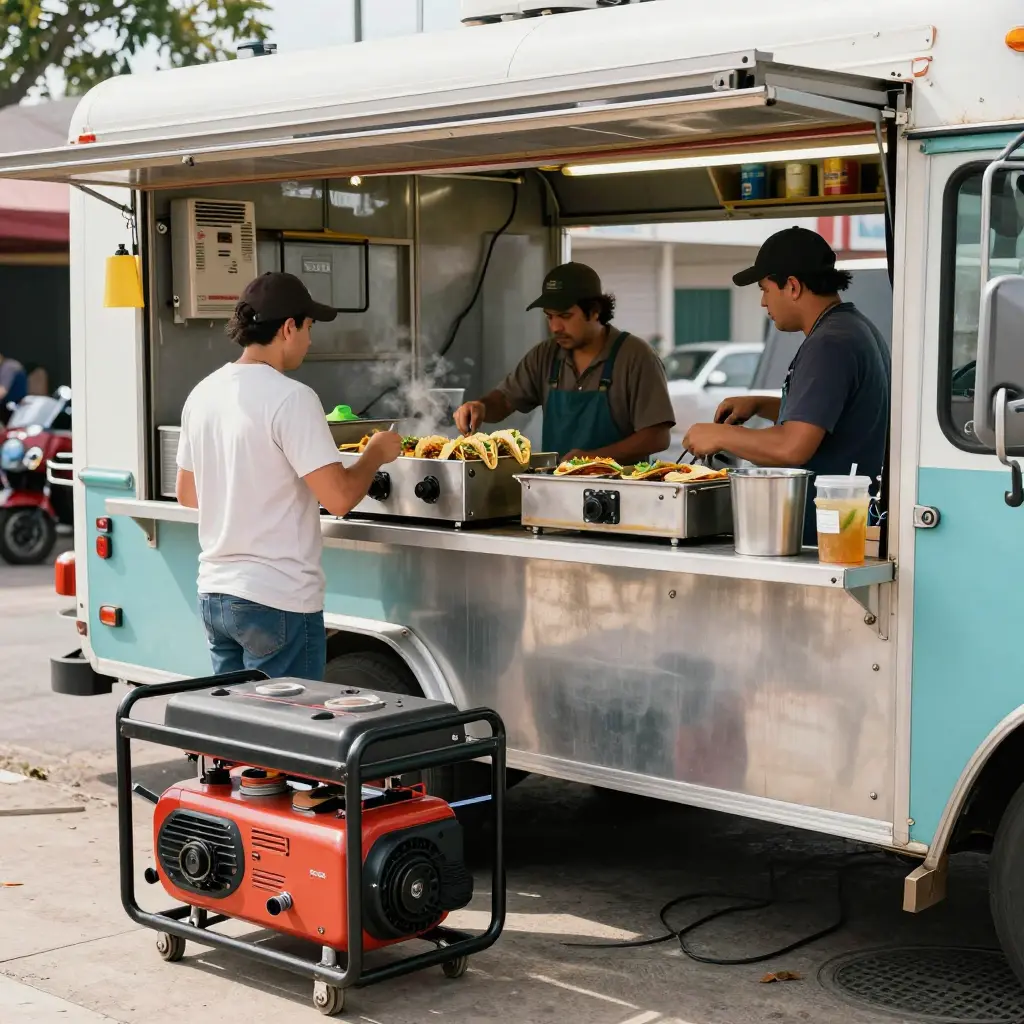
Why Your Taco Truck Generator Trips During the Lunch Rush
When a food truck generator trips during the lunch rush, the machine itself is usually fine. The problem is that the load no longer matches the equipment. A taco truck that fires up the flat-top, the fryer, the commercial refrigerator, the exhaust fan, and the POS system inside the same ten-minute window pulls far more power than it does on a quiet afternoon. Compressors and motors add brief inrush current on top of that, so demand climbs highest at the exact moment it matters most.
A generator that ran smoothly at 11 a.m. can still lack the taco truck generator capacity to carry a combined peak load at 12:30. Once demand passes a unit’s continuous rating, either the breaker trips or the engine stalls, both of which are protective responses.
Peak-load failures start as electrical problems rather than mechanical ones, so it helps to cover the causes first, then sizing, then what a bigger generator costs in equipment, fuel, and installation. For your menu, see how to size your food truck equipment wisely.
Noon is the worst time for a generator to quit, right when every burner, fridge, and microwave fires up at once. The failure is rarely random. To understand why generators trip on a busy taco truck, separate two kinds of power: what equipment uses while it runs, and what it demands the instant it starts.
Running Watts vs. Surge Watts
Running watts keep an appliance going once it is on. Motors and compressors, however, need a burst to start, and that burst is measured in surge watts. It can reach two to three times the running value: a fridge drawing 400 running watts may pull 1,200 watts for a split second. Across a dozen devices, those spikes add up quickly.
Why Simultaneous Startup Overwhelms the Generator
A generator rated for your total running load can still buckle when several devices surge together, because food truck power needs are not a sum of averages. They include startup spikes. The usual triggers:
- Griddle and grill motors kicking on at the same moment
- Refrigerator and freezer compressors cycling together
- A microwave’s magnetron firing while the fryer heats
- A blender or small power tool adding sudden inrush current
- Air conditioning starting as the cabin heats up
Power Factor and Voltage Drop
Motors run below a 1.0 power factor, so part of the current they draw does no useful work. That “reactive” current still loads the generator. A weak supply sags under it, and as voltage drops, appliances pull more current to compensate, which deepens the sag.
Heat and Protective Shutdown
As current climbs and voltage sags, wires and windings heat up. Breakers trip to protect the circuit, and the generator’s own overload protection may shut down the whole unit. Sizing equipment correctly starts before you plug anything in, so take the time to choose food truck equipment wisely. Plan for surge, not averages, and the midday rush keeps moving.
Why Your Food Truck Generator Trips at the Lunch Rush: Six Causes
During a packed lunch service, every appliance on the truck pulls hard at once, and that collision of demand is where overload almost always starts. The six causes below account for most mid-rush shutdowns, and each one comes with a quick check you can run before your next shift. Work through them alongside smarter food truck generator sizing and equipment choices, and the line keeps moving.
- Simultaneous startup of high-draw appliances. Flipping on the griddle, fryer, and fridge at once creates an inrush current spike that dwarfs normal running watts and trips the breaker instantly. Try staggering the power-ups 10-15 seconds apart and see whether the trip stops.
- An undersized generator for the true peak load. Plenty of rigs are matched to average draw instead of the worst-case peak load, so the math works on paper but fails at noon. Add the running and startup watts on every appliance nameplate and compare the total with your generator’s continuous rating.
- One appliance quietly drawing more than its label claims. A failing compressor or a worn heating element can pull 20-30% extra current and shove an otherwise healthy setup into overload. A clamp meter around each circuit will show how the live draw compares with the nameplate rating.
- Shared breakers and thin extension cords. Daisy-chaining two appliances onto one circuit, or running high-wattage gear through a light cord, adds resistance and heat that mimics a genuine overload. Confirm that each large appliance has its own dedicated circuit and a cord rated for the load.
- Low voltage and fuel starvation under demand. A restricted fuel line or clogged air filter lets the engine bog down, so output sags and voltage collapses exactly when everything is running. Watch the voltmeter and listen for engine surging at peak load.
- Heat buildup and blocked ventilation. Enclosed compartments trap hot air, and a generator that can’t cool loses capacity just as cabinet temperatures climb. Keep the vents clear and feel the exhaust area for excessive heat after 30 minutes of service.
None of these checks takes more than a few minutes. If the same breaker keeps tripping after you rule out the easy fixes, revisit your food truck generator sizing with a proper load calculation.
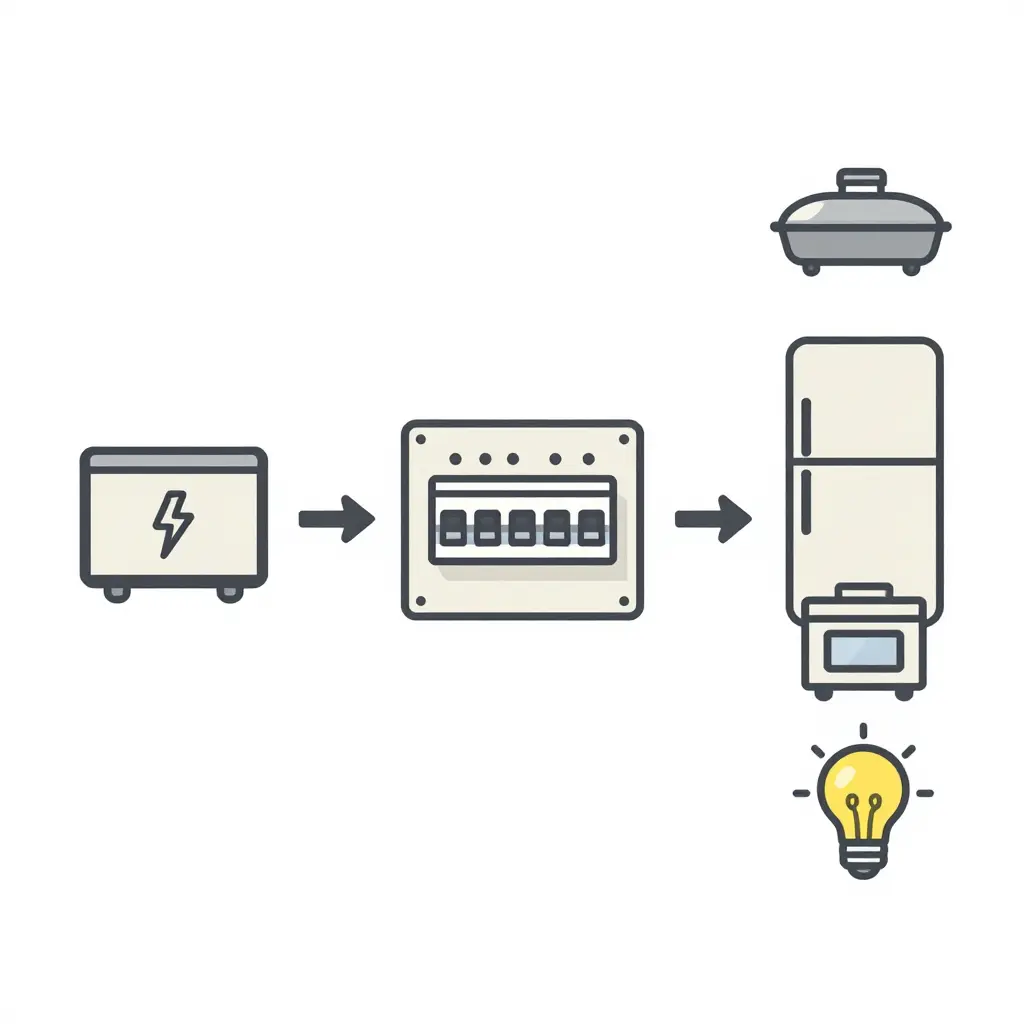
How the Load Actually Reaches Your Appliances
Before you blame the generator itself, trace the path the power travels. Electricity leaves the generator, passes through the distribution panel (the breaker box), and then splits into separate circuits that feed each appliance. When one circuit pulls more than its share, its breaker trips to protect the wiring – which is why a tripped breaker is often a distribution problem, not a generator-size problem.
That distinction matters when you add equipment for a busy lunch rush. If your griddle, fryer, and refrigerator all demand power on the same circuit, no amount of generator capacity will fix an overloaded panel. Map your circuits first, then match appliances to the right feeds. For gear that plays nicely with your existing setup, see these tips on how to choose food truck equipment wisely.
Sizing a Generator Correctly for a Taco Truck
Getting food truck generator sizing right comes down to one skill: adding up what the equipment actually needs. Guess too low and you trip breakers mid-rush; guess too high and you overspend on fuel and hardware. The math is straightforward.
Running watts versus starting watts
Running watts, sometimes called continuous watts, is the steady power an appliance draws in normal operation. Starting watts, or surge watts, is the brief extra burst a motor needs to spin up. A refrigerator might hum along at 300 watts yet surge past 1,500 for a second at startup.
Continuous versus peak ratings
Generators advertise two figures: a continuous (rated) rating for sustained output and a peak (surge) rating for short spikes. Plan your everyday load around the continuous rating only.
Mind the power factor
Power factor compares real power (watts) to apparent power (volt-amperes). Motors and electronics often run below 1.0, so a generator rated in VA can deliver fewer usable watts than the label implies.
Respect the safety margin
Keep your total continuous load under about 80 percent of rated generator capacity. That headroom absorbs surges, reduces heat build-up, and extends the unit’s lifespan. Building a menu around the right equipment makes this easier, so learn more about choosing food truck equipment wisely.
Total your load step by step
Add the continuous watts of everything running at once, then add the largest motor’s surge (its starting watts minus its running watts). Match that combined total to a generator whose continuous rating clears it with room to spare. Do this once and every service window stays powered.
Typical Power Draw of Common Food Truck Appliances
Nothing exposes a generator that’s too small faster than the lunch rush. The griddle is hot, the fridge kicks on, someone hits the blender, the starting surges stack up, and the breaker trips. Before you spec a bigger generator, know what each appliance actually pulls. Use the reference ranges below as a quick planning tool, and pair them with smart food truck equipment choices so your build stays efficient.
| Appliance | Typical Running Watts | Typical Surge/Starting Watts | Notes |
|---|---|---|---|
| Electric griddle (36″) | 1,500 – 3,000 | 1,500 – 3,000 | Resistive heating element; almost no surge, but draws heavily the entire time it is on. |
| Deep fryer (double basket) | 1,500 – 2,500 | 1,500 – 2,600 | Resistive load, so surge stays close to running watts. Running two units can double the load. |
| Commercial refrigerator | 300 – 800 | 1,200 – 2,300 | Compressor motor peaks at start-up (roughly 3-5x running watts); cycles on and off throughout service. |
| Microwave (commercial) | 1,000 – 1,500 | 1,000 – 1,600 | High draw in short bursts with minimal surge, but it stacks on top of whatever else is already running. |
| Coffee machine (espresso) | 1,200 – 2,000 | 1,200 – 2,000 | Heating element dominates the load; steady resistive draw while it heats water. |
| Blender (commercial) | 300 – 1,500 | 1,500 – 2,500 | Motor start-up creates a brief but sharp surge that is easy to overlook. |
| Exhaust fan | 100 – 500 | 200 – 1,000 | Motor-driven with a short surge; often runs continuously during service. |
| LED lighting | 10 – 100 | 10 – 100 | Very low draw and negligible surge. A full interior and exterior setup rarely totals more than 200 W. |
Actual draw varies by model, age, manufacturer, and how the appliance is wired, so always confirm the nameplate rating on your own units. Add up the running watts for everything on at once, then layer in the surge watts of the largest motor starting last – that combined peak is the number your generator has to survive without tripping.
How to Calculate Surge Capacity for the Lunch Rush
The lunch rush is the one moment your food truck’s electrical system earns its keep, and the moment it is most likely to trip. Size your power for that demand, not just the calm hours between orders. The quickest way is to work out your surge capacity: the extra burst a generator must deliver when a motor or compressor first kicks on. Here is a simple method anyone can follow:
- List every appliance that could run at once. Include the fridge, fryer, griddle, espresso machine, lights, POS system, and anything else plugged in.
- Sum the running watts. Add the steady-state draw of each item. This total is your baseline load.
- Identify the appliance with the highest starting watts. Motors and compressors surge when they start, often two to three times their running rating. Find the single biggest spike.
- Swap that appliance’s running watts for its starting watts, then add the rest. Count only the largest surge, not every surge, because appliances rarely start at the exact same second.
A worked example
Say the running watts of everything except the largest motor come to 3,850 W, and that motor pulls 5,400 W when it starts. Your minimum generator size for food truck operation is 3,850 + 5,400 = 9,250 W. Buying a unit rated below that number means a tripped breaker right at noon, when the griddle and fridge are both demanding power.
A generator with clean surge headroom keeps everything running while the fridge cycles. To get the input figures right, choose food truck equipment wisely and note each appliance’s rated and starting watts before you shop.
The Lunch Rush Power Demand Curve: When Your Generator Waves the White Flag
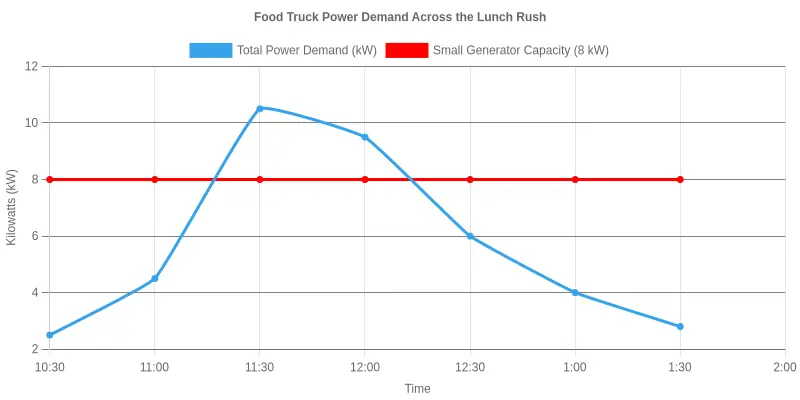
If you have ever watched your generator trip at the worst possible moment – right in the middle of a lunch line ten deep – you already know the pain. The chart below shows what the load is doing.
Reading the Curve
Notice how the demand line stays comfortably low through the mid-morning prep window, hovering between 2.5 and 4.5 kW as you fire up the flat-top and warm the fryer. Then, right around 11:45 AM, everything switches on at once:
- The griddle goes full blast
- The fryer cycles on to keep up with orders
- The fridge compressor kicks in as doors open and close constantly
- Lights, POS system, and the exhaust fan are all drawing power simultaneously
That is the classic lunch rush power demand spike. It peaks near 10.5 kW around noon and stays above 9 kW for about half an hour.
Why the Smaller Generator Fails
The red dashed line marks an 8 kW generator’s capacity. The blue demand curve punches straight through it. That crossover point is the overload: for a brief but critical window, your equipment is asking for more power than the generator can deliver, and every trip you experience is the system protecting itself.
| Time | Power Demand | vs. 8 kW Capacity |
|---|---|---|
| 10:30 AM | 2.5 kW | Comfortable |
| 11:30 AM | 4.5 kW | Comfortable |
| 12:00 PM | 10.5 kW | Overloaded |
| 12:30 PM | 9.5 kW | Overloaded |
| 1:00 PM | 6.0 kW | Comfortable |
| 2:00 PM | 2.8 kW | Comfortable |
The lesson is simple: an 8 kW unit is fine for idle mornings, but only a 12 kW setup with load management or a 15 kW+ unit will carry you clean through peak service without a single trip. Before you spend a dollar, it pays to choose food truck equipment wisely so your power plan matches your actual menu demands.
What Drives the Cost of a Bigger Food Truck Generator
Generator Output Size (kW)
The biggest factor behind bigger generator cost is raw output. Moving from a 5 kW unit to a 12-15 kW model usually runs $2,500-$6,000, while 20 kW-and-up systems can top $10,000. A higher kW rating means more copper windings, heavier frames, and stronger cooling, all of which raise the price.
Inverter vs. Conventional
Conventional generators are cheaper upfront, often $1,500-$4,000, while inverter units cost more, roughly $3,000-$8,000. Inverters deliver cleaner power and run quieter, which protects your POS terminals, fridges, and electronics.
Fuel Type
Gasoline units cost least to buy but more per hour to run. Propane sits in the middle. Diesel is the priciest, about $4,000-$12,000, yet it burns the most efficiently over a long lunch rush.
Brand and Durability
Budget generators start near $1,000. Commercial-grade brands such as Cummins, Kohler, and Onan command $5,000-$15,000, a premium that buys longer warranties, better parts availability, and machines that hold up to daily use. When you’re choosing food truck equipment wisely, brand support matters as much as sticker price.
Noise Level, Enclosure, and Weatherproofing
Quiet, fully enclosed, weatherproof housings add $1,000-$3,000 on their own. Sound-dampening panels and marine-grade enclosures protect the unit through rain, grease, and daily washdowns.
Wiring and Panel Upgrades
A larger generator usually demands heavier-gauge wiring, a new transfer switch, and bigger breaker panels, which adds $500-$2,500 depending on your truck’s layout.
Installation Labor
Professional installation runs $500-$2,000, and more if your truck needs structural reinforcement or new ventilation.
Costs vary because every truck carries a different electrical load with different space and existing wiring. Two owners can complete the same food truck generator upgrade and pay very different totals.
Where the Money Goes: A Bigger Generator Cost Breakdown
When Don’s taco truck conks out at the lunch rush, most owners fixate on one number: the sticker price of a replacement generator. The real cost is never just the unit. By the time a new genset is bolted in, wired up, and spinning without tripping the breaker, you have paid for a whole system of upgrades. The doughnut chart below shows how a typical budget splits across the parts that actually matter.
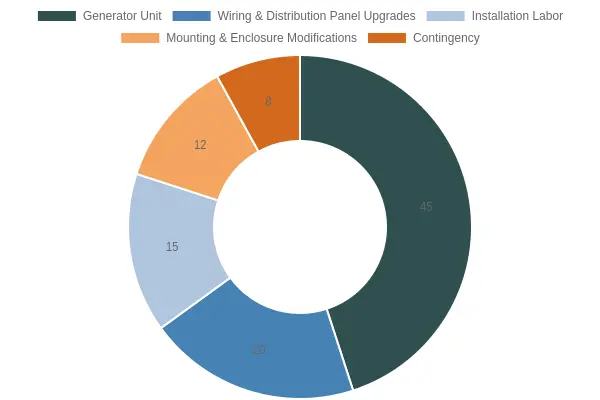
Where the Other 55% Goes
The generator unit takes the largest share at 45%, because a machine rated to carry a griddle, fridge, fryer, and exhaust fan all at once costs real money. The other 55% is where most first-time buyers get blindsided:
| Cost Component | Share | What It Covers |
|---|---|---|
| Generator unit | 45% | The new genset itself, sized to your true peak load |
| Wiring & distribution panel upgrades | 20% | Heavier gauge cabling, breaker panel, transfer switch |
| Installation labor | 15% | Certified electrician hours, testing, and load checks |
| Mounting & enclosure modifications | 12% | Reinforced brackets, ventilation, weatherproof housing |
| Contingency | 8% | Surprises: rust, clearance issues, last-minute parts |
Why the Hidden Slices Matter
An undersized generator keeps tripping no matter how well you cook. On an upgrade, your existing wiring may no longer be rated for the new amperage, so the distribution panel often needs a full swap. Labor is not optional either – miswired gensets are a fire risk. And the mounting costs are easy to overlook until the old cradle cannot hold the new weight or the enclosure traps heat.
Budget the full picture, not just the headline. Before you commit, it pays to choose food truck equipment wisely so every dollar lines up with the load you actually run.
What a Realistic Quote Includes
If someone quotes you a price for a “bigger generator” and it only reflects the unit, ask what else is included. A realistic quote folds in wiring, panel, labor, mounting, and a contingency cushion – the same five slices in the chart above. Plan for all of them, and the lunch rush stops being a gamble.
Food Truck Generator Sizes and Typical Price Ranges
The figures below are general reference ranges for generators commonly used on food trucks, and prices swing widely with brand, inverter technology, and where you buy. Your actual quote also depends on region, fuel type, and whether you choose a budget import or a premium name brand. Use these as a budgeting starting point, then choose food truck equipment wisely by matching the generator to your real appliance load instead of the number on the box.
| Generator Output (kW) | Suitable Truck Size / Appliance Load | Generator Type | Typical Price Range (USD) |
|---|---|---|---|
| 3-4 kW | Small trailers; lights, POS, fridge, and one small fryer | Portable / inverter, gas | $600 – $1,500 |
| 5-7 kW | Mid-size trucks; griddle, single fryer, fridge, and lights | Inverter or open-frame, gas | $1,200 – $3,000 |
| 8-12 kW | Large trucks; multiple fryers, griddle, fridge, and A/C | Commercial-grade, gas or diesel | $2,500 – $6,500 |
| 13-20 kW | Heavy-duty rigs; full kitchen plus A/C and extras | Diesel or propane genset, stationary | $5,000 – $15,000+ |
The Real Cost of Upsizing Your Generator
A bigger generator solves nuisance tripping at the lunch rush, but it also rewrites your weekly budget. Understanding food truck generator running costs before you buy avoids an expensive surprise later.
Fuel is the first line item. A compact 4 kW unit sips roughly 0.3 to 0.5 gallons per hour, while a 7 to 9 kW model can burn 0.7 to 1.1 gallons per hour under load. Over a six-hour service day, that gap easily adds up to several gallons, often $30 to $60 per week at current prices. Matching food truck power needs to the right wattage avoids the extra gallons an oversized unit burns, so learn how to right-size your setup when you choose food truck equipment wisely.
Weight matters too. Heavier units can add 100 to 200 pounds, directly eating into payload capacity for food, propane, and water. That means fewer restock trips or a swap to a lighter build.
Maintenance and service intervals tighten as well. Larger engines need more frequent oil changes, filter replacements, and carbon-monoxide checks. Noise rules add another constraint: many cities cap generator noise at a set decibel level, and louder units can trigger complaints or fines.
Finally, plan for supporting hardware. A sturdier mounting system reduces vibration damage, and upgraded ventilation keeps exhaust safely away from your cooking line. Budget for all of it up front using proven strategies for managing equipment costs and tariffs, so a bigger generator stays a profit tool instead of a money pit.