
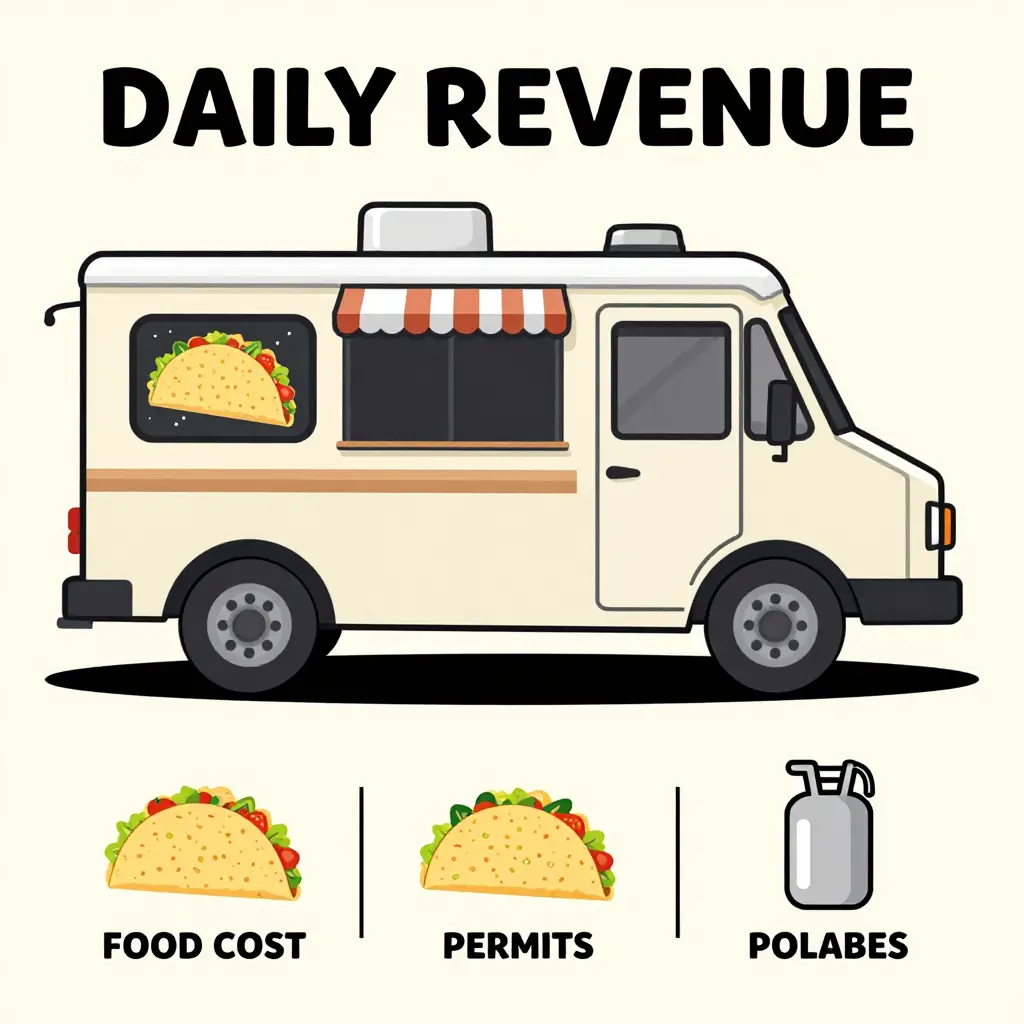
How Much a Taco Truck Makes: Breaking Down Daily Sales Minus Costs
What a taco truck makes at the end of the day is one subtraction: gross daily sales minus food cost, permits, and propane. Get those three numbers roughly right and you can judge whether a route, a menu, or a second truck is worth the money. Get them wrong and you are guessing with your savings.
Daily sales set the ceiling; food cost, permits, and propane set the floor. Food cost usually takes 28-35% of revenue. Permits and propane are smaller line items, but new operators underestimate them because they arrive on a different schedule: permits once or twice a year, propane with every refill. Costs move month to month too, so the daily numbers matter more than the annual ones. Equipment plays into this. Choosing equipment wisely cuts both electricity and propane use, and those savings repeat on every service day.
The sections below cover realistic daily sales, food-cost ratios, permit fees, and what propane and fuel actually cost.
Daily Sales Revenue: What a Taco Truck Actually Rings Up
Food truck daily sales swing widely. On a typical weekday most trucks ring up $300 to $800, and a few clear $1,000. Weekend events and festivals commonly land between $800 and $2,500 because crowds stay longer and spend more. A strong lunch rush in a busy district can bring in $250 to $600 in two to three hours, and a single catering gig usually pays a flat $700 to $2,000 depending on headcount and menu.
For full-time operators, annual income usually lands between $40,000 and $100,000. The spread depends on consistency and on whether the truck fits its market. Trucks working steady commuter districts generally earn more than rural routes, and rotating among several dense spots evens out the slow days.
Four things move daily sales:
- Location traffic: foot and vehicle volume shape transaction counts.
- Operating hours: longer, well-timed shifts capture more meal windows.
- Average ticket size: combos and add-ons lift the total per customer.
- Menu pricing: competitive prices balance margin against volume.
Uptime matters as much as foot traffic. A truck only earns on days it opens, so equipment reliability and vehicle upkeep, including the coatings care that keeps trucks serving customers, decide how many selling days you get. Do maintenance in slow periods and the truck stays available when sales are strongest.
Taco Truck Daily Sales vs. Operating Cost Categories
| Cost Category | Typical Daily Range (USD) | Percentage of Daily Sales | Notes |
|---|---|---|---|
| Gross Daily Sales | $800 – $1,500 | 100% | Revenue before any expenses |
| Food Cost (COGS) | $240 – $500 | 28% – 35% | Tortillas, meat, produce, salsa |
| Permits and Licensing (daily amortized) | $5 – $15 | 0.5% – 1% | Annual fees split per day |
| Propane | $15 – $40 | 2% – 3% | Cooking, heating, generator fuel |
| Fuel and Vehicle | $30 – $70 | 3% – 5% | Gas, upkeep, smart equipment choices |
| Commissary/Lot Fees | $20 – $60 | 2% – 5% | Prep space and parking spot |
| Net Daily Profit | $200 – $450 | 15% – 30% | Take-home after all costs |
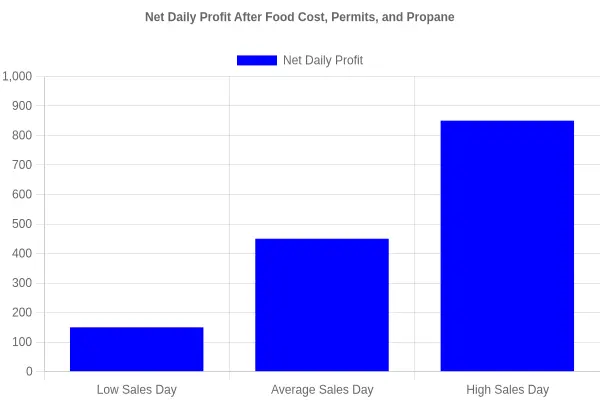
Figure: Net Daily Profit After Food Cost, Permits, and Propane
The chart compares net profit at three sales volumes: a Low Sales Day at roughly $150, an Average Sales Day near $450, and a High Sales Day at about $850, after food cost, permits, and propane come out. The pattern is the point. A busy day does not simply add customers; it leaves more of each sale once fixed and variable costs are paid.
Permits and Licensing: The Fixed Costs That Follow You Every Day
Permits are recurring, not one-time startup fees. You pay them whether or not you open the window, which is what makes them a fixed cost and why they belong in the daily break-even math.
- Health department permits: routine inspections and food-safety licensing to operate legally.
- Business licenses: local and state registration required before you sell.
- Mobile food vending permits: municipal approval to park and sell at specific sites.
- Fire certificates and lot/commissary agreements: safety certification plus prep-space or parking access.
Combined licensing usually runs $1,500 to $5,000 a year, depending on the city. At a mid-range $3,000 spread over 300 operating days, that is about $10 a day before you sell a single taco.
That amount comes straight out of net earnings. At $500 in daily sales, with $150 for food and $60 for propane and fuel, $10 in permits is roughly 2% of a thin margin. Sell only 200 days in a year and the same permits cost $15 a day.
Organized records make inspections and renewals easier to predict. The sustainable practices for mobile food trucks guide covers the operating habits that help.
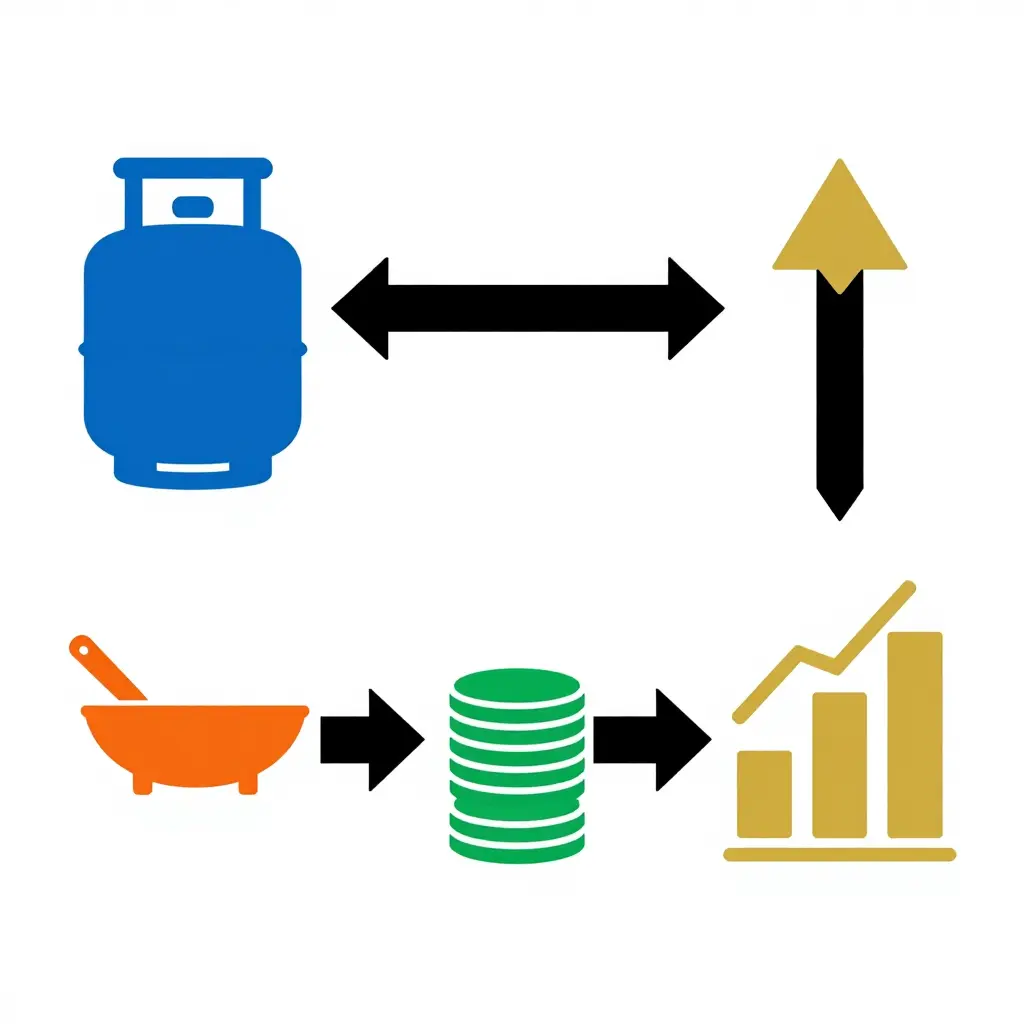
The diagram shows the path: the propane tank feeds the cooking equipment, that use becomes a daily propane cost, and the cost comes off net profit. Treated that way, propane is a line item to manage, not an afterthought.
Propane and Fuel: The Small Line Items That Add Up
Propane is easy to overlook because it is bought a tank at a time, not a week at a time. A busy truck running flat-tops, griddles, and fryers burns 3 to 5 gallons a service day. At $3.50 to $4.50 per gallon, that works out to roughly $12 to $22 daily, or $300 to $550 per month at five to six days a week. Most operators track it through refills: a 20-pound tank exchange costs about $18 to $25, while a 100-pound tank refill runs $80 to $120 depending on region and season.
Weather moves the number. Cold months burn more gas to hold cooking temperatures, and long summer festival shifts push daily use toward the top of the range. Slow winter weeks cut it sharply.
Fuel has two parts. Driving between the commissary, service spots, and events burns diesel or gas; the generator powering lights, refrigeration, and the POS system burns gasoline. Budget $15 to $40 daily for the vehicle and $10 to $25 for the generator, or roughly $500 to $1,300 per month combined. Propane-efficient cooking equipment keeps burn rates low and refills rare; choosing food truck equipment wisely explains how.
Ways to Lower Taco Truck Costs Without Cutting Quality
You can trim costs without cutting fillings. Most of the savings come from buying, prep, and routing habits rather than cheaper ingredients. Eight moves that protect flavor:
-
Buy ingredients in bulk. Restaurant suppliers and local markets sell meat, tortillas, and produce at wholesale prices. Bigger orders lower the per-unit cost, and you can split a pallet with another vendor when storage is tight.
-
Manage propane tanks smartly. Weigh tanks before each shift so you neither over-buy nor run dry mid-service. Insulating the cooking area and turning burners down between orders stretches every gallon.
-
Schedule routes to cut fuel use. Cluster stops into tight loops instead of zigzagging across town. Fewer miles means less diesel, less wear, and more time parked where the customers actually are.
-
Time your permits right. Renew annual permits and schedule health inspections during slow seasons, when fees and lines are lighter. Knowing your city’s calendar avoids rush fees and keeps you compliant.
-
Standardize your portions. Measuring scoops and a written recipe card for every taco curb costly over-serving and keep the plate consistent whether you or a new hire is cooking.
-
Batch your prep. Chop onions, grill proteins, and mix salsas in one morning push rather than small batches all day. Batching saves labor hours and cuts the energy the kitchen burns during service.
-
Maintain your equipment. Clean griddles, check connections, and service the generator on a schedule. Well-kept gear lasts longer and runs cheaper, so choose food truck equipment wisely before you replace anything.
-
Track your waste. Log what gets thrown out each night. The pattern shows which ingredients you are over-ordering, and small buying changes add up week after week.
Calculating Net Profit: Daily Sales Minus Food Cost, Permits, and Propane
The calculation is repeatable. Start with gross daily sales, the total cash taken at the window before any expense is paid.
Step 1 – Gross daily sales. Say a solid weekday brings in $1,200.
Step 2 – Subtract food cost. At a typical 30 percent ratio, that is $360 in ingredients.
Step 3 – Subtract daily-amortized permits. An annual $3,000 permit spread across 250 selling days equals $12 per day.
Step 4 – Subtract propane. If a $60 tank lasts two days, the daily propane cost is $30.
Step 5 – Subtract fuel and other variable costs. Commute fuel, napkins, and packaging add $48.
Net profit = Gross daily sales – food cost – permits – propane – fuel and other variable costs
Applied here: $1,200 – $360 – $12 – $30 – $48 = $750.
How the result shifts by day type
A low sales day drops gross to $600. Food cost falls to $180, but permits and propane stay put, so net profit lands around $330.
A high sales day raises gross to $2,000. Food cost climbs to $600, while fixed items barely move, pushing net profit to about $1,310.
Volume drives net profit, because fixed daily costs are spread across more sales on busy days. Track each line separately and the margins stay honest. To control equipment-driven expenses, review how to choose food truck equipment wisely.
Where Your Daily Dollars Actually Go
The bar chart showed dollars. The doughnut chart shows proportion, which makes the biggest categories obvious. Food Cost leads at 42%, followed by Other Overhead (20%) and Fuel and Vehicle (18%). Propane takes 12%, while Permits and Licensing is the smallest recurring piece at 8%.
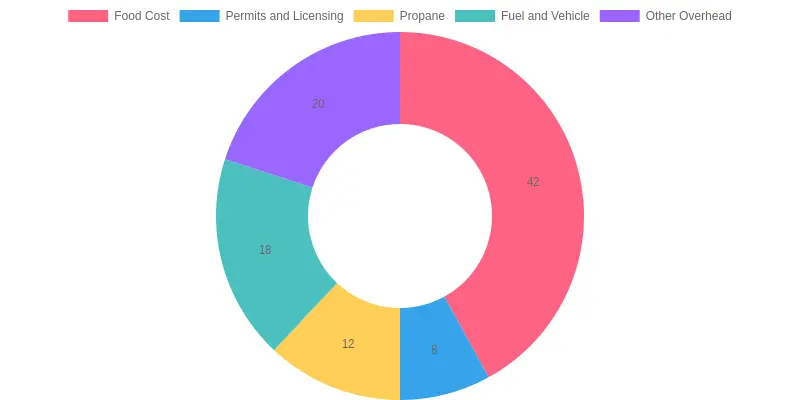
| Cost Category | Share of Daily Costs |
|---|---|
| Food Cost | 42% |
| Other Overhead | 20% |
| Fuel and Vehicle | 18% |
| Propane | 12% |
| Permits and Licensing | 8% |
Food and fuel, the two biggest variable costs, make up 60% of daily spending. That is why ingredient sourcing and route efficiency move the bottom line more than a few dollars shaved off a fixed expense. Equipment that trims overhead is one of the fastest ways to protect the margin.
Frequently Asked Questions About Taco Truck Earnings
How much does a taco truck make per day?
A well-run truck brings in $800 to $2,500 in daily sales, depending on location and foot traffic. What it actually makes is gross revenue minus operating expenses such as ingredients, fuel, and staffing.
What percentage goes to food cost?
Food cost takes 28% to 35% of taco truck revenue. Owners who negotiate with suppliers and cut waste often hold it near 30%, which leaves more room for payroll and equipment. Tracking portions daily protects the margin over time.
How much do permits cost?
Permits vary widely by city, usually $100 to $1,000 a year for health, business, and parking licenses, and some municipalities charge extra for prime vending spots. Budget for them upfront so renewals do not surprise you.
How much propane does a taco truck use daily?
A busy truck burns roughly three to six gallons of propane a day running grills, fryers, and refrigerators. Propane averages $15 to $40 daily, so choosing food truck equipment wisely helps reduce waste and control fuel spending.
What is a healthy profit margin?
A healthy margin falls between 10% and 20% of gross sales. Operators at 15% or higher typically keep tight food costs, efficient scheduling, and strong pricing. Below 10%, it is time to rework the menu and the spending.
How long until a taco truck breaks even?
Most trucks break even within 12 to 24 months, depending on startup costs and sales volume. Consistent locations and repeat customers shorten that timeline. Tracking weekly earnings lets owners adjust faster and recover the investment sooner.
Key Takeaways on Taco Truck Earnings
Net profit equals daily sales minus food cost, permits, and propane. Staffing, parking, and everything else sit on top of that core calculation. Food cost is the largest variable, swinging with ingredient prices, portion control, and menu mix, which is why it is worth tracking weekly rather than once a quarter.
For most well-run trucks, the profit is steady rather than dramatic. A reliable performer might net a few hundred dollars on a good day and far less on a slow one, while strong operators in high-traffic spots earn more. The difference comes down to how closely operating costs are managed.
When sales soften, the strategies for truck dealers in sales decline guide covers turnaround approaches that transfer to food trucks. The operators who stay profitable watch fuel, propane, and food costs continuously, because those margins decide the long run.